


H2 Chemistry Practical: Lessons From NYJC Paper 4 | A-Level Guide
If you want to be one of the strongest H2 Chemistry students in your cohort, Paper 4 cannot be treated as the paper you simply “hope goes well”.
You can know your reactions. You can memorise your qualitative analysis observations. You can be excellent at calculations.
Then the practical starts.
A gas escapes before you are ready to test it.
Your titration solution suddenly changes colour near the endpoint.
You realise halfway through an experiment that you should have prepared your table before you started.
That is the difference between knowing Chemistry and executing Chemistry under exam conditions.
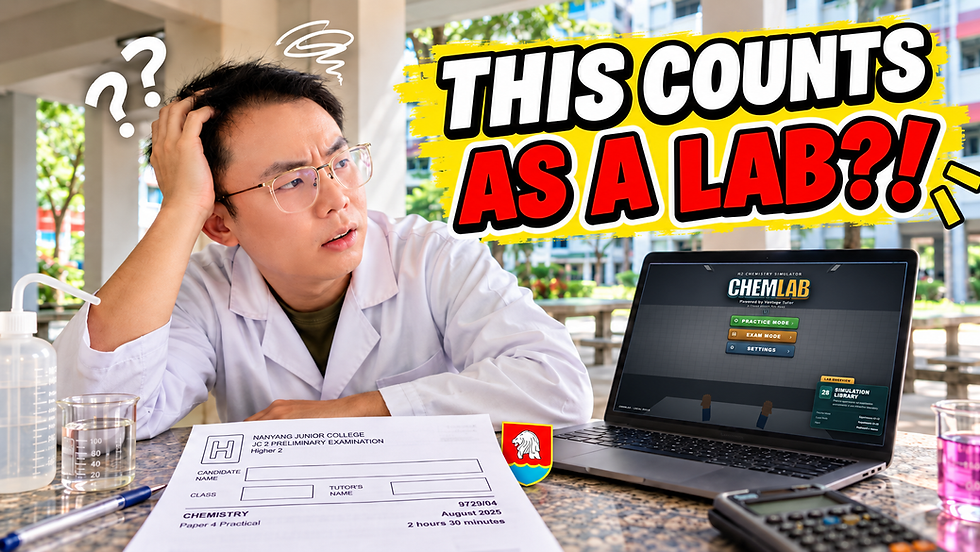
To see how much of that execution can actually be practised outside a laboratory, I attempted the 2025 Nanyang Junior College H2 Chemistry Paper 4 Practical under an HDB void deck using my ChemLab practical simulator.
It turned out to be a much better test than I expected.
What makes H2 Chemistry Paper 4 difficult?
Paper 4 is unusual because revision is constrained by something students cannot fully control: access to a laboratory.
For your written papers, you can attempt another question whenever you want.
You can do another mechanism.
Another energetics calculation.
Another equilibrium question.
But you cannot simply decide at 10pm that you would like to practise a titration.
That creates a dangerous gap.
Students often spend hundreds of hours developing their theoretical Chemistry but have far fewer opportunities to practise the decisions they must make during an actual experiment.
And Paper 4 tests a lot more than whether you remember what colour a precipitate should be.
It tests whether you can:
recognise what equipment you need before the reaction begins; record data efficiently; notice -unexpected observations; manage several experimental processes at once; interpret observations correctly; and recover when something does not go according to plan.
The 2025 NYJC practical demonstrated almost all of these.
Lesson 1: Prepare before the reaction starts
One of my mistakes happened during qualitative analysis.
I added a substance and unexpectedly obtained effervescence.
There was just one problem.
I wasn't ready to test the gas.
By the time I found what I needed, much of it had already escaped.
That sounds like a small mistake.
It wasn't.
Later, it affected my ability to identify one of the ions correctly. During my review, I realised that failing to properly investigate that gas was exactly why I could not confidently identify the carbonate.
There is a larger lesson here.
Do not wait for an observation before thinking about what the observation could be.
If an experiment could produce a gas, think about your gas tests beforehand.
If you expect a precipitate, think about whether you may need to test its solubility in excess reagent.
If heating is involved, think about what needs to be prepared before the reaction begins.
Strong practical students are often not dramatically faster than everyone else.
They are simply one step ahead of the experiment.
Lesson 2: Draw your results table before you need it
This sounds basic.
It is also exactly the type of basic thing students neglect when the clock starts running.
Before beginning the energetics experiment, I prepared the table first rather than trying to construct it while measurements were already being generated.
That matters because experimental data does not wait for you.
If you're measuring something every 30 seconds, you don't want to spend one of those 30 seconds wondering where to write your next value.
And the same principle applies to titration.
Your table is not merely:
initial readingfinal readingvolume used
You need the appropriate headings and units as well.
These are not intellectually difficult marks.
Which is exactly why losing them hurts.
Lesson 3: Waiting time is still exam time
Some practical experiments contain unavoidable waiting.
The temptation is to mentally switch off.
Don't.
During the energetics section, there were stretches where I was simply waiting for the next temperature reading.
That time can be used to look ahead at the calculation, identify what data you will eventually require and understand what the next part of the experiment is asking.
There is an important distinction, though.
Using waiting time intelligently is not the same as trying to do five things at once.
If the experiment requires close monitoring, monitor it.
The objective is not maximum busyness.
The objective is maximum control.
That is a useful mindset across the entire A-Level examination.
Lesson 4: Your data booklet will not save you
One of the more interesting parts of the NYJC paper was its qualitative analysis.
At one point, I found myself trying to identify an ion and realised the A-Level data booklet wasn't going to simply hand me the answer.
I had to reach back into Chemistry knowledge that students may associate with earlier parts of their education and reason through the observations instead.
This is something ambitious H2 Chemistry students should pay attention to.
A practical examination does not exist in a neat little box called “Practical”.
Your knowledge of:
qualitative analysis, transition metals, redox chemistry, organic functional groups and acid-base behaviour can all become relevant.
You are not just following instructions.
You are interpreting Chemistry as it happens in front of you.
That is why memorising an observation table without understanding the chemistry behind it has limits.
Lesson 5: Do not throw things away too quickly
During the QA experiment, I was lucky I had not discarded one of my earlier solutions.
That allowed me to return to it when I realised another test was needed.
In a real practical, this habit matters.
Unless you are certain you are finished with a solution, be careful about washing everything away immediately.
You may need to:
repeat an observation, perform another test, verify a conclusion or recover from an earlier mistake.
The same applies to preparing reagents.
Good laboratory management is part of good examination technique.
The strangest part of the NYJC practical
The most interesting experiment in the paper was the titration.
This was not simply:
fill burette → titrate → look for endpoint.
The solution had to be kept above a certain temperature during the titration. If it cooled too much, a brown species appeared and interfered with the visibility of the endpoint.
And that is almost exactly what happened to me.
Close to the endpoint, the solution turned brown.
For a moment, I thought I had overshot the titration completely.
That forced me to manage two things simultaneously:
temperature and titration accuracy.
Eventually I repeated the titration and obtained a sufficiently consistent second result, confirming that the first endpoint had not been as disastrous as I initially feared.
This is exactly the type of practical experience that is difficult to gain by reading notes.
You can understand the sentence:
Maintain the solution above 65°C.
But until you experience what happens when it drops below that temperature at the worst possible moment, the instruction can feel abstract.
That is one reason practical exposure matters.
So, is the 2025 NYJC H2 Chemistry Paper 4 difficult?
I would describe it as slightly above average rather than unfairly difficult.
The paper contains familiar components, but NYJC introduces enough unusual decisions to make students think.
The energetics section is relatively conventional.
The QA is more demanding because students have to interpret observations carefully.
And the titration adds an unusual temperature-management component that can easily disrupt someone who is used to completely standard titrations.
That makes it useful revision.
Not because I expect your A-Level practical to reproduce NYJC's experiment exactly.
That is the wrong way to use prelim papers.
The value comes from experiencing an unfamiliar situation and asking:
Can I still make sensible Chemistry decisions when the experiment does something I haven't rehearsed exactly before?
That is the skill you actually want.
How should you prepare for H2 Chemistry Practical?
If you're aiming for an A, I would stop thinking of practical revision as:
“What experiment is likely to come out?”
Instead, think:
“What could happen during an experiment, and would I know what to do?”
You want enough exposure that unfamiliarity stops being frightening.
A new titration should still feel like a titration.
An unusual QA sequence should still feel like Chemistry you understand.
An unexpected observation should make you curious rather than cause you to panic.
Your goal is not to predict the exact experiment Cambridge will give you.
Your goal is to become difficult to surprise.
Can you practise H2 Chemistry Paper 4 at home?
You cannot reproduce every aspect of a physical laboratory on a computer.
Nor should anyone pretend otherwise.
Handling actual apparatus, judging a real meniscus, transferring solutions and physically controlling equipment still matter.
But there is a large part of practical performance that involves decision-making, and that can be practised far more frequently than most students currently practise it.
That is why I built ChemLab.
The idea is not to replace your school's laboratory.
It is to let you practise practical situations when the laboratory is unavailable.
In the NYJC challenge, I could work through energetics, inorganic and organic qualitative analysis, reagent preparation, volumetric procedures and the unusual heated titration from underneath an HDB block. The exercise still exposed real mistakes in the way I approached the experiment.
That is what makes simulation useful.
You get another attempt.
Another mistake.
Another chance to recognise what you should have done differently.
If you want to be excellent at H2 Chemistry, stop protecting yourself from mistakes
There was something I liked about this challenge that had nothing to do with whether I looked competent on camera.
I made mistakes.
I missed things.
I repeated one mistake several times.
And the simulator exposed them.
That is useful.
A lot of students revise in environments where they constantly feel like they understand Chemistry.
They read notes they already understand.
They review solutions after seeing the answer.
They repeat comfortable question types.
It feels productive because very little goes wrong.
But the examination does not care how comfortable revision felt.
If you're trying to become one of the strongest H2 Chemistry students, you should actively seek situations that reveal weaknesses before Cambridge gets the opportunity to reveal them for you.
That applies to practical.
It applies to Paper 2.
It applies to organic mechanisms.
It applies to every part of H2 Chemistry.
The best revision does not constantly reassure you that you're good.
It shows you exactly where you're still vulnerable.
And then gives you enough time to fix it.
Watch the full NYJC Paper 4 challenge
In the full video, I attempt the 2025 NYJC H2 Chemistry Paper 4 Practical using ChemLab from an HDB void deck, including the energetics experiment, inorganic and organic qualitative analysis, and the heated titration.
I also review the paper at the end and explain who I think should attempt it before the A Levels.


Comments